

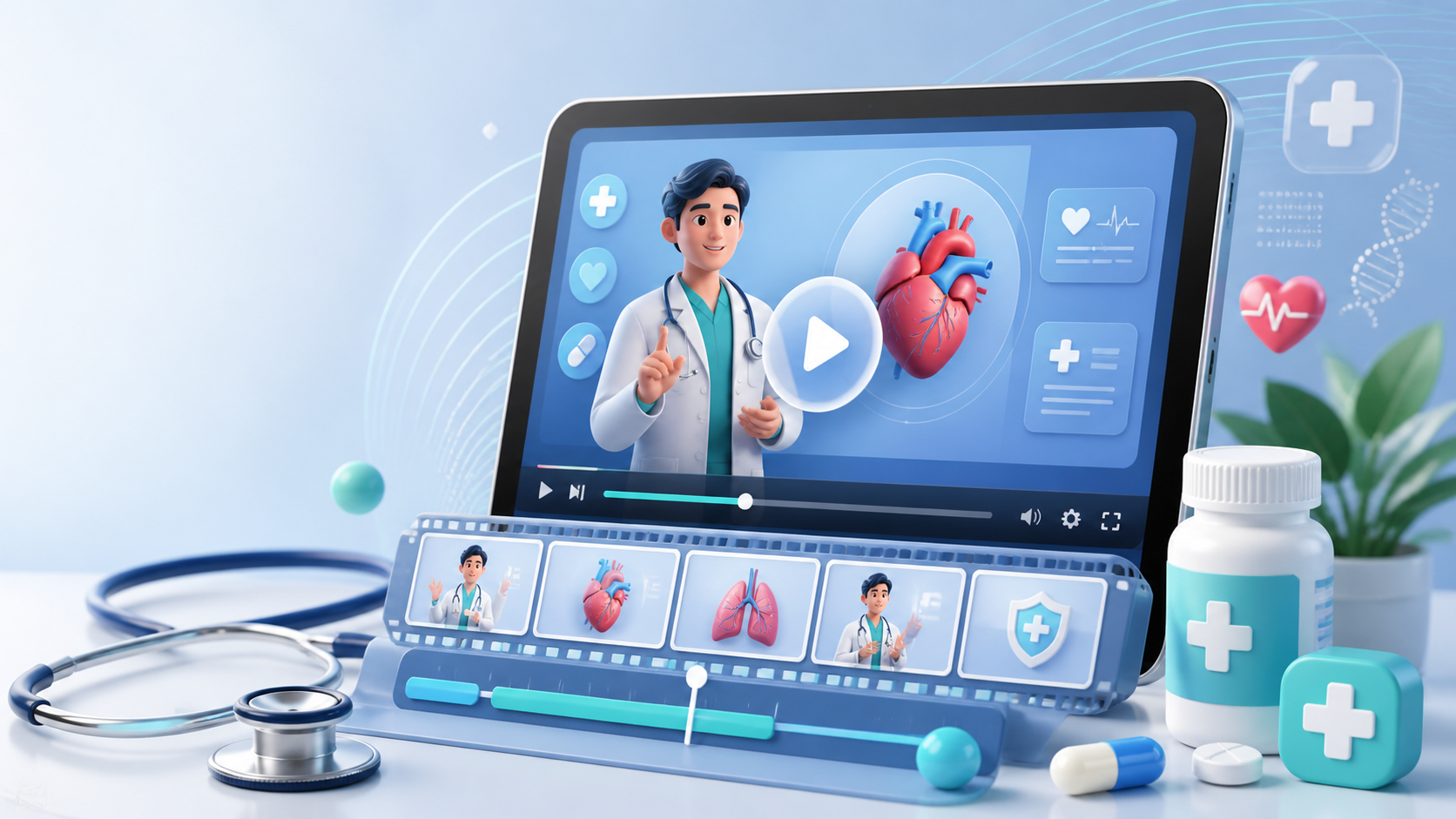
Animation videos are playing an increasingly important role in the healthcare industry. Mordor Intelligence states that 3D animation captured 44.2% of the medical animation market in 2024. This shows that more and more medical professionals are realizing the benefits of healthcare animation video in medical procedures.
Before, medical information was mostly shared through textbooks, brochures, and verbal explanations. Although these methods were informative, they were difficult for patients to understand. It was a challenge for those with no medical background to understand medical terms, diagrams, and procedures.
Now, science and visual storytelling are combined as Medical Video Animation that helps healthcare professionals to explain diseases, treatments, and prevention in an engaging way.
What is Medical Video Animation?
Medical animation or healthcare video animation is a type of animation that combines 2D and 3D visual storytelling to explain medical topics and healthcare procedures to those who have no medical background. This is a method that makes a complex concept easy to understand visually. This method is commonly used for:
- Explaining diseases and conditions.
- Demonstrating surgical procedures.
- Educating patients about medical treatments.
- Training med students and professionals.
- Promoting healthcare services.
These animations work as the bridge that connects medical experts and the general public.
History of Medical Visualization
Do you know what life was like before the emergence of digital animations? The medical education was dependent on hand-drawn illustrations and physical models. These methods were helpful, but there were certain limitations. Professionals were not able to show movements or biological processes. For instance,
- Blood Circulation
- Cellular Activities
- Organ Functions
- Surgical Procedures were a challenge to explain.
Professionals faced difficulty to explain these without static images. With time, new technologies were introduced, they were tested, and used in medical classes. With time, healthcare animation video started providing a better way to visualize the dynamic systems.
The Rise of 3D Medical Video Animations
With time and constant testing, a 3D animation USA has made its place in the lives of professionals. With revolutionizing healthcare communications, advanced medical graphics made it possible to create realistic models of organs, cells, and biological systems.
Now, with time, these animations allow viewers to:
- Explore the human body in detail.
- Understand the way diseases develop.
- See how treatments work inside the body.
- Visualize surgical procedures step-by-step.
This realistic representation improved the understanding of both patients and professionals.
How Medical Animation Supports the Healthcare Industry
The healthcare industry not just focus on conducting the procedures, but their role is to educate the individuals at the same time. They promote awareness and encourage preventive care for the upcoming spell of illness.
-
Simplifies Complex Medical Concepts
Those with no medical background or those with some knowledge of the diseases find medical topics complicated. Animation breaks down these ideas into simple visuals. You will learn,
- The spread of Viruses.
- The way Medication affects the body.
- The way the Organs function.
- And a small change in lifestyle contributes to better health.
This makes the medical information easy to explain and accessible to a wider audience.
-
Improves Patient Education
There are times when most patients have difficulty understanding a diagnosis or a treatment plan. A healthcare animation video makes it possible by helping doctors explain procedures visually. Patients are able to view,
- Things that will happen inside their body.
- The way the disease progressed, and
- The procedure will help with that issue.
This explanation improves the patient’s confidence and builds trust.
-
Enhances Public Health Awareness
Apart from the use in hospital and clinical settings, patient education animation is part of public health campaigns. Some of the common topics that are discussed include:
- Vaccination Awareness.
- Disease Prevention.
- Mental Health Education.
- Nutrition and lifestyle guidance.
Through visual storytelling, these campaigns reach larger audiences and improve health awareness.
-
Support Medical Training and Education
Additionally, medical schools and hospitals in the USA use medical animation USA to train healthcare professionals. Through the use of visuals, professionals are taught,
- Surgical techniques.
- Anatomy and physiology.
- Medical device usage.
- Emergency procedures.
This way, students learn faster, even when the topics are complex, and theoretical knowledge is not just enough to clear concepts.
-
Strongest Component for Digital Healthcare Marketing
Hospitals and clinics use animations not just to teach complex topics, but also to promote their services online through this tool. When videos explain treatments or procedures, this helps patients to understand things they can expect. This is beneficial because,
- It leads to better engagement on websites and social media.
- A clearer communication of services.
- It helps build the strongest relationship of trust between healthcare providers and patients.
This is something that is best for both educational and marketing perspectives.
What is the Expected Future of Medical Animations?
In the coming years, healthcare animation video will be one of the exciting elements that will be used for interactive learning. This teaching technique is merged with the emerging technologies that make healthcare education more immersive. Some of the upcoming trends include,
- Interactive learning experiences.
- Virtual reality medical training.
- Personalized patient education tools.
- AI-assisted medical visualization.
These developments are tested and will continue to become better with the medical information that will be shared and understood.
Conclusion
The use of animations in the medical industry has transformed healthcare communication. Things that in the past were dependent on static diagrams and complex explanations are now replaced with more engaging and visual storytelling. Explaining a complex topic has become easier with the advancement of technology. A healthcare animation video will continue to help professionals. Now, experts and patients can easily connect and communicate in a clearer and meaningful manner.
FAQs
What is Medical Video Animation used for?
Medical animation is used to explain diseases, treatments, surgical procedures, and health concepts through visual storytelling.
Why is Medical Video Animation important for patient education?
It simplifies complex medical information, making it easier for patients to understand their condition and treatment options.
Can Medical Video Animation help in public health campaigns?
Yes. It is widely used to educate communities about disease prevention, vaccinations, and healthy lifestyles.
Is Medical Video Animation used in medical schools?
Yes. Medical institutions use animation to teach anatomy, physiology, and surgical techniques.
How does Medical Video Animation improve healthcare communication?
It turns complex scientific information into clear visual explanations that are easier for people to understand.